Reviewing the Easter Teacher PNG for Embroidery Projects
As a designer who spends more time staring at stitch maps than I do sleeping, I have learned to approach digital assets with a healthy dose of skepticism. We are constantly bombarded with files that look crisp on a screen but turn into a tangled mess of thread breaks and puckering once they hit the fabric. When I first encountered the Easter Teacher Png, Happy Easter Png, my initial reaction was cautious. This is not a vector file, nor is it a native machine embroidery format like PES or DST. It is a high-resolution graphic, specifically a 300dpi PNG intended for print or as a reference for digitizing. However, in the world of modern crafting, the line between print-on-demand and traditional stitching is blurring. Many of us use these graphics for sublimation transfers onto embroidered blanks, or we use them as visual guides to manually digitize custom motifs for our clients.
First Impressions and Visual Personality
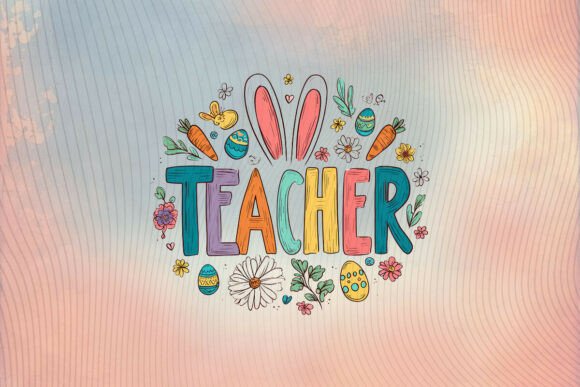
The mood of this design is unmistakably cheerful and professional. It strikes a balance that is often difficult to achieve: it is festive without being childish, and appreciative without being overly sentimental. For an Illustrations category asset, the clarity is paramount. At 300dpi, the edges are sharp, which is critical whether you are printing this directly onto a tote bag or using it as a template for hand-guided embroidery. The layout suggests a central focus, likely featuring typographic elements combined with seasonal iconography. In my experience, designs labeled for "teachers" need to exude a certain level of polish. Parents and school administrators are the buyers here, and they expect a finished product that looks intentional, not like a last-minute craft project. This graphic delivers that sense of curated professionalism.
Real-World Application: The Spring Tote Bag Scenario
Let’s walk through a realistic scenario. Imagine you run a small Etsy shop specializing in personalized gifts for educators. Spring is approaching, and you want to launch a limited-run collection. You decide to create a heavy-canvas tote bag. Since the Easter Teacher Png, Happy Easter Png is a print file and not an SVG or embroidery file, you cannot simply load it into your Brother or Janome machine. Instead, you have two viable paths. First, you could use direct-to-film (DTF) printing or sublimation to apply the graphic onto a pre-embroidered blank. Second, and more commonly for high-end boutiques, you would use this PNG as a visual reference to digitize a simplified version for machine embroidery.
If you choose the latter, the graphic serves as your north star. You trace the main shapes to create your applique design or fill stitch areas. The benefit of having a high-quality PNG like this is that you can zoom in to see exactly how the lines flow. This helps in determining where to place running stitch outlines versus where to use dense satin columns. For a tote bag, durability is key. A design that relies too heavily on tiny, intricate details will wear out quickly. By studying this graphic, I can see which elements are bold enough to survive daily use and which might need to be simplified during the digitizing process.
Performance on Different Fabrics and Garments
Versatility is the hallmark of a good design asset. While this is a Graphics file, its utility extends across various substrates. Consider a fleece sweatshirt. Fleece is thick and plush, which can swallow up fine details. If you are using this image to guide an embroidery project on a sweatshirt, you need to ensure that any lettering is large enough to remain legible. The contrast in the PNG helps you visualize this. If the text in the graphic is thin, you know immediately that you need to adjust your font choice or increase the stroke width in your digitizing software.
For lighter fabrics, such as a cotton apron or a kitchen towel, the stakes are different. Here, stitch density becomes a major concern. If you digitize based on this image and make the fill areas too dense, the fabric will pucker and distort. The clean lines of the Easter Teacher Png, Happy Easter Png allow you to plan for open spaces. You might choose to use a satin stitch border with a light fill, or even leave parts of the design as negative space to let the fabric texture show through. This approach not only saves thread but also results in a softer, more flexible finished product that feels premium to the touch.
Challenges with Curved Surfaces and Dark Fabrics
Not every application is straightforward. If you are considering this design for a cap or a curved surface, you must be wary of distortion. Caps have a limited hoop area and a curved structure that pushes stitches outward. Using a complex graphic as a reference for cap embroidery requires simplification. You might need to isolate just the central icon from the Easter Teacher Png, Happy Easter Png and drop the surrounding text to ensure it fits within a standard 4x4 or 5x7 hoop without crowding the seams.
Dark fabrics present another challenge. Since this is a PNG, it likely has a transparent or white background. If you are printing it, you need a white underbase. If you are embroidering based on it, you need to consider thread colors carefully. Light pastels, common in Easter themes, may not pop against navy or black fabric. You might need to add a layer of white stabilizer or use a thicker thread weight to ensure visibility. Always test your color combinations on scrap fabric before committing to the final garment.
Commercial Value and Brand Consistency
For the Etsy seller or craft business owner, consistency is brand currency. Using high-quality design assets like this ensures that your mockups look professional. Even if you are not selling the digital file itself, the quality of your source material reflects on your handmade product. A pixelated or poorly designed reference leads to poor digitizing, which leads to unhappy customers. By starting with a crisp 300dpi PNG, you set yourself up for success. It allows you to create accurate printable mockup previews for your online store, giving customers a realistic expectation of the final item.
Moreover, the theme of teacher appreciation is evergreen. While the "Easter" label ties it to a specific season, the sentiment of gratitude is universal. With slight modifications in color or context, the underlying structure of such a design can be adapted for end-of-year gifts, making it a versatile addition to your library of commercial embroidery references.
Practical Designer Notes and Best Practices
Before you rush to production, keep these practical tips in mind when working with this type of asset:
- Verify Licensing: The product description states this is a cut or print file. It explicitly mentions it is not an SVG and not for editing in the sense of vector manipulation. Ensure you understand the license terms regarding commercial use. Can you sell items made with this print? Can you use it as a reference for digitizing? Always clarify this with the creator.
- Test on Scraps: Never stitch directly on your final garment. Use scrap pieces of the same fabric and stabilizer combination you plan to use. This helps you check for registration issues and thread tension.
- Check Contrast: View the PNG in black and white. If the design loses its definition in grayscale, it will likely struggle in embroidery where color contrast is limited by thread availability.
- Hoop Size Matters: Confirm the dimensions of the graphic. If it is too large for your standard hoops, you may need to split the design or scale it down, which could affect readability.
- Stabilizer Selection: For stretchy fabrics like t-shirts, use a cut-away stabilizer. For woven fabrics like tote bags, a tear-away might suffice. The right stabilizer prevents the distortion that can ruin even the best-digitized design.
In conclusion, the Easter Teacher Png, Happy Easter Png is a solid resource for designers who understand its limitations and strengths. It is not a plug-and-play embroidery file, but rather a high-quality visual foundation. For those willing to put in the work to translate this graphic into stitches, or to use it for high-quality printing, it offers a professional, festive aesthetic that resonates with buyers. Treat it as a tool in your kit, respect the technical requirements of your medium, and you will create products that stand out in a crowded market.